
A used car located across a state line may offer better equipment, lower mileage or a more attractive price, but distance adds obligations that are easy to overlook. You must confirm who owns the vehicle, whether the title can transfer, how taxes will be assessed and what your home DMV requires before it issues permanent plates. This guide walks through those decisions in the order that protects your money and avoids preventable delays.
Before You Buy: Understand Which State Controls the Paperwork
Buying a used car across state lines can expand your choices, but the advertised price is only one part of the transaction. The vehicle may be titled in the seller’s state while taxes, emissions compliance, insurance and permanent registration depend on where you live. Before sending a deposit, confirm the car can legally be titled and registered at home, not merely driven away from the seller’s lot. The listing does not answer those questions.
Start with USA.gov vehicle registration guidance and your home motor vehicle agency’s specific instructions for an out-of-state purchase. Some jurisdictions require a VIN inspection, safety or emissions test, proof of sales tax, or additional ownership documentation. Other states offer different procedures for private sales and dealer transactions. Treat this as a two-state process: the seller must transfer valid ownership, and your home state must accept the evidence when you apply for a new title and plates.
Verify the Seller, VIN and Ownership Before Sending Money
Ask for a clear photograph of the current title, with sensitive personal details appropriately protected, and compare the vehicle identification number with the listing and the physical car. The named owner should be the person legally authorized to sell, or a dealer should be able to explain its authority and documentation. If a lender appears on the title, request the exact lien-release procedure and verify that the seller can deliver acceptable ownership documents before the balance is paid.
The National Motor Vehicle Title Information System can help consumers access participating title-history information; a vehicle history report can reveal reported title brands, prior damage, odometer events and other recorded information, but it is not a substitute for an independent inspection. Use the VIN to review available records, compare the seller’s claims with service documents, and arrange a qualified mechanic near the vehicle. Our VIN and vehicle history guide explains what different records can and cannot establish. When reviewing archived vehicle listings or reported incidents, cleanautohistory.com may be part of a broader research process; independently verify anything material before committing.
If the seller refuses an inspection, cannot identify the legal owner, pressures you to pay before sharing documents, or gives conflicting answers about a branded title, stop and resolve the discrepancy. A distant purchase removes the convenience of returning to the seller for missing signatures. Protect yourself by obtaining the documents, confirming the seller’s identity and establishing a written plan for how the original title and any lien release will reach you.
Know Which Title Documents You Will Need
The certificate of title is the central ownership record, but the documents needed for an interstate transaction can include a signed bill of sale, odometer disclosure, dealer purchase agreement, lien release and state-specific title application. The correct combination depends on vehicle age, seller type, title format and both states’ rules. Never assume that a notarized bill of sale alone replaces a properly assigned title, and do not accept a photocopy when the receiving agency requires the original.
Our title transfer guide explains the difference between ownership transfer and registration. Before you travel, ask your home DMV how the seller should complete the assignment and whether the state requires a VIN verification. For an electronic title, confirm who initiates the release or interstate conversion. If the document contains an error, consult the guide to correcting a car title rather than altering signed fields yourself.
A seller may describe a vehicle as having a “clean title” when the physical certificate is still held by a lender, or when a replacement application is pending. Those are materially different situations. Get a written explanation of who possesses the title, what signatures are needed, and when you will receive the document. Get a written completion date, not a vague promise.
How Sales Tax Works When the Car Crosses State Lines
Sales tax is often the biggest surprise in an out-of-state purchase because the tax obligation is not automatically determined by the seller’s location. Your home state may assess tax when you title or register the vehicle, sometimes allowing credit for qualifying tax already paid elsewhere. Dealer collection arrangements also differ. Do not assume that paying a dealership’s quoted tax settles every obligation, or that buying from a private seller makes the transaction tax-free.
Ask your home tax or motor vehicle agency for the current rule based on your residence, the seller’s state, vehicle price and seller type. Request an itemized buyer’s order showing any tax collected, the collecting jurisdiction and the documentation you will receive. If a dealer offers to handle your registration, confirm exactly which fees it collects and which tasks remain yours. Official state instructions should override informal estimates from online calculators.
Keep the purchase agreement, proof of tax paid and any trade-in documentation because these can affect the taxable amount or eligibility for a credit where state law permits one. If you finance the car, ask whether tax is paid at closing or due separately when you register. The distinction matters for cash planning: a low purchase price can still require a substantial payment at your home DMV within a short deadline.
Temporary Tags, Insurance and the Trip Home
You need a lawful way to move the vehicle before permanent plates are issued. Depending on the jurisdiction, this may involve a dealer-issued temporary tag, an in-transit permit, a temporary registration or transport on a trailer. Rules can differ for a vehicle purchased from a private seller, and a temporary permit from the selling state may not solve every issue in your home state. Verify the permitted route, expiration date and required paperwork before departure.
Arrange insurance effective before you take possession and confirm coverage for the specific VIN. Ask the insurer what proof you should carry while driving through other states. A newly purchased car is not automatically safe or roadworthy merely because it has a temporary plate. Check tires, lights, brakes, fluid leaks and recall status, and consider roadside assistance if the vehicle will make a long interstate trip.
If the car is not registered or mechanically ready for the journey, professional transport may be safer than driving. Compare enclosed and open-carrier quotes, pickup windows, insurance terms and delivery conditions. Document the car’s condition with dated photographs before loading and at delivery. That evidence helps resolve transport damage disputes and prevents the purchase from becoming a rushed cross-country handoff.
Calculate the Real Out-the-Door Price
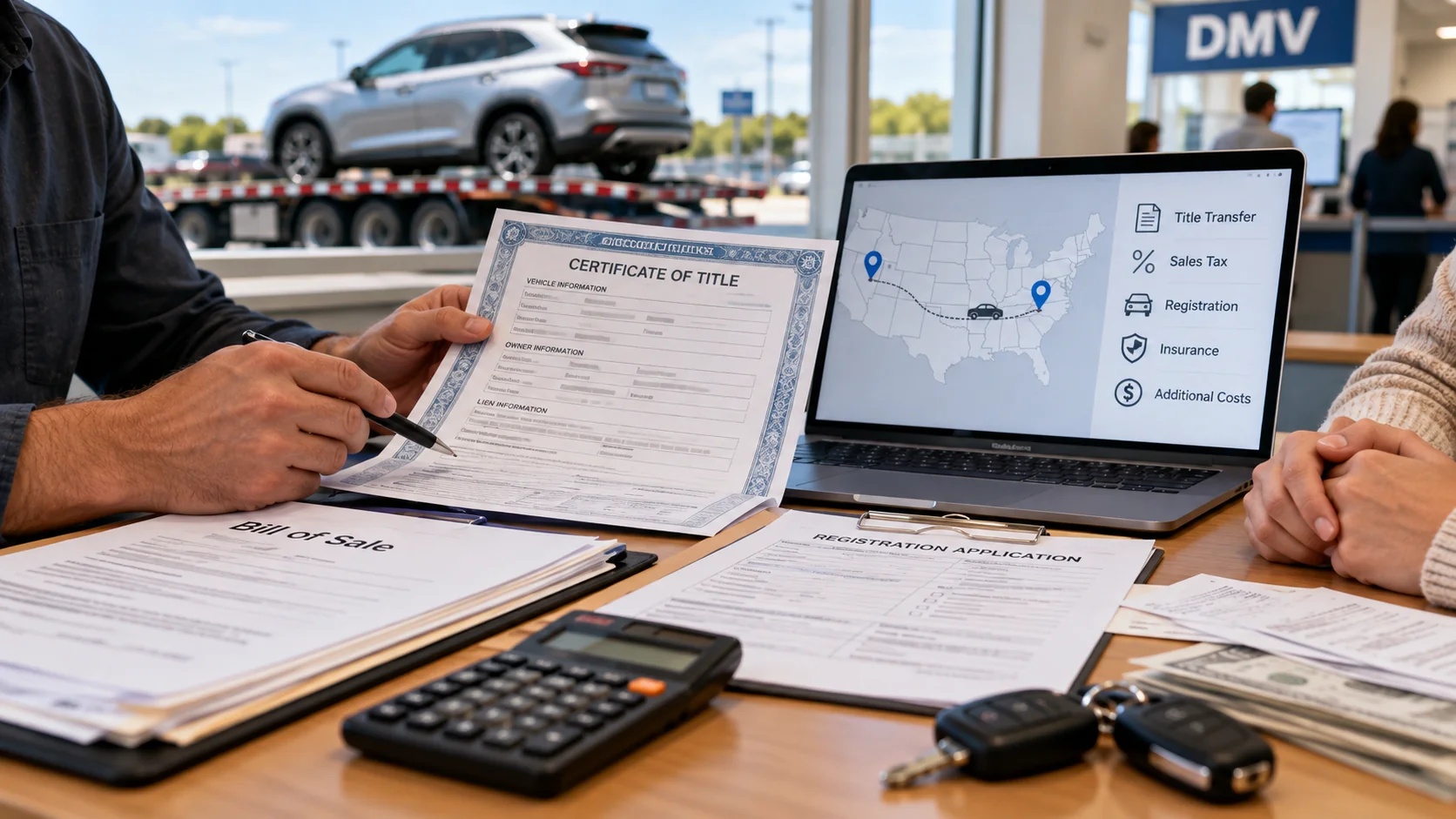
The number that matters is the complete amount required to purchase, move and legally operate the vehicle at home. Include the negotiated price, applicable taxes, title and registration fees, temporary permit, inspection, transportation and immediate repairs. Some charges are known in advance, while others should be estimated conservatively until a mechanic and your home DMV confirm them. The comparison should be between total delivered costs, not two advertisements.
For example, a vehicle listed for $16,000 in another state may appear $1,200 cheaper than a similar local car. If transportation costs $700, inspection and travel cost $350, and additional registration-related expenses add $250, the apparent saving disappears before any repair reserve. These figures are illustrative, not universal state fees. A cheaper sticker price is worthwhile only when the condition, paperwork and final budget still compare favorably.
A Practical Interstate Purchase Checklist
A remote purchase requires checks before payment. Prepare a short checklist and assign each item to the buyer, seller, lender or shipping company. Confirm each dependency before moving to the next stage: you should not schedule nonrefundable transport while the title is unresolved, and you should not wire a balance before the agreed inspection and ownership checks are complete.
Complete these steps in order before accepting delivery:
- Confirm the home-state title, tax, emissions and registration requirements directly with the responsible agency.
- Match the VIN and seller identity to the title, listing, bill of sale and vehicle.
- Order a vehicle history review and an independent mechanical inspection before committing funds.
- Agree in writing on the price, included fees, payment method, title delivery and lien payoff.
- Arrange valid insurance and a lawful temporary permit or licensed carrier for transportation.
- Receive original ownership documents, register by the applicable deadline and retain all receipts.
This sequence reduces avoidable surprises, but it does not replace your state’s instructions or a lawyer’s advice in a disputed ownership transaction. A dealership may perform several tasks on your behalf, yet you should still request copies and verify the outcome. For a private sale, use a secure payment arrangement and keep communication records until the new title is issued in your name.
Dealer Versus Private Seller: Different Risks
The FTC’s used-car buying guidance is useful when evaluating dealer representations. A licensed dealer may be able to coordinate financing, taxes, temporary registration and title transfer, but these services are not automatic across state lines. Request a buyer’s order that separates the vehicle price from document fees, add-ons, delivery charges and taxes. Verify any promise to obtain home-state plates, especially if the dealer operates primarily in another jurisdiction. A “turnkey” sale is only turnkey when each obligation is clearly assigned.
A private seller may offer a lower price, but you usually carry more responsibility for confirming title status, arranging inspections and submitting registration documents. Meet safely, verify the seller’s identification, check the original title and document payment carefully. Our private-seller paperwork checklist provides a companion review for the handoff. Avoid sending money to an unrelated person or accepting a title already signed to an unknown third party.
Red Flags That Should Stop an Out-of-State Deal
Interstate distance can make ordinary paperwork errors expensive and can also create opportunities for fraud. Be skeptical of a seller who refuses to provide a VIN, claims a title is “in the mail” without proof, demands payment through irreversible channels, or insists that a third-party shipper will release the vehicle only after another surprise fee. Compare the seller’s address, business identity, title details and payment instructions before committing.
Pay particular attention to these warning signs:
- A seller name that does not match the title or an unexplained chain of ownership.
- VIN discrepancies, undisclosed title brands, odometer inconsistencies or missing lien releases.
- Pressure to skip an independent inspection or pay a deposit before receiving basic records.
- Unexpected transport, storage, tax or escrow demands introduced after the agreed price.
- Promises that your home state will register the car without any supporting documentation.
One concern does not always prove fraud, but a cluster of inconsistencies should change your decision. Save screenshots of the advertisement, messages, inspection findings and payment instructions. If the vehicle cannot be independently verified or the seller will not document the transaction, walking away is usually less costly than pursuing a distant title dispute.
Register the Vehicle in Your Home State
Once the vehicle arrives, apply for title and registration within your state’s deadline. Bring the assigned title, identification, insurance evidence, purchase contract, tax documentation and any required VIN or emissions inspection results. Some states have additional rules for imported, salvage, rebuilt or recently financed vehicles. The exact checklist should come from your home agency, not from a generic national form.
Check the new title carefully when it is issued, including the owner name, VIN, lienholder and address. Keep copies of the bill of sale and any temporary permits until permanent documents arrive. If you recently moved, the registration-after-moving guide explains related timing and document issues. An interstate purchase is truly complete when ownership and registration are accepted, not merely when the keys change hands.
Conclusion
Buying a used car from another state can be worthwhile when the vehicle is genuinely better, rarer or more competitively priced than local alternatives. The safest approach is to verify the seller and title first, inspect the vehicle independently, calculate all taxes and delivery costs, and confirm your home state will accept the documents. Build enough time into the deal for liens, temporary permits and registration rather than relying on a seller’s promise that everything will be simple.
Use written agreements, official agency guidance and a realistic out-the-door budget to compare the interstate option with a local purchase. If the paperwork is incomplete or the vehicle cannot be inspected, the apparent discount may not justify the risk. A good purchase is not just a low price: it is a car you can legally title, insure, register and drive without inheriting unresolved problems.
Frequently Asked Questions
Do I pay sales tax in the state where I buy the car?
Not necessarily. Your home state may collect tax when you register the vehicle, and credits for tax paid elsewhere depend on state rules. Ask your home tax or motor vehicle agency and obtain itemized proof of any tax the seller collects.
Can I drive an out-of-state car home without plates?
Do not assume you can. You may need a temporary permit, dealer-issued tag or licensed transport, depending on the states involved and the seller type. Confirm legal requirements and arrange insurance before taking possession.
Do I need the original title for an interstate purchase?
Many states require a properly assigned original certificate or a recognized electronic-title transfer, along with other documents. Check your home agency’s instructions before paying; a bill of sale alone may not establish transferable ownership.
Should I get a mechanic to inspect a car in another state?
Yes, an independent pre-purchase inspection is particularly valuable when you cannot easily revisit the seller. Ask for a written report, photographs and any recommended follow-up tests. A history report cannot confirm the current mechanical condition.
Can a dealer register the car in my home state?
Some dealers coordinate interstate title and registration, but availability and responsibilities vary. Get the service and fees in writing, confirm what documents you will receive, and verify whether you must complete inspections or other steps yourself.