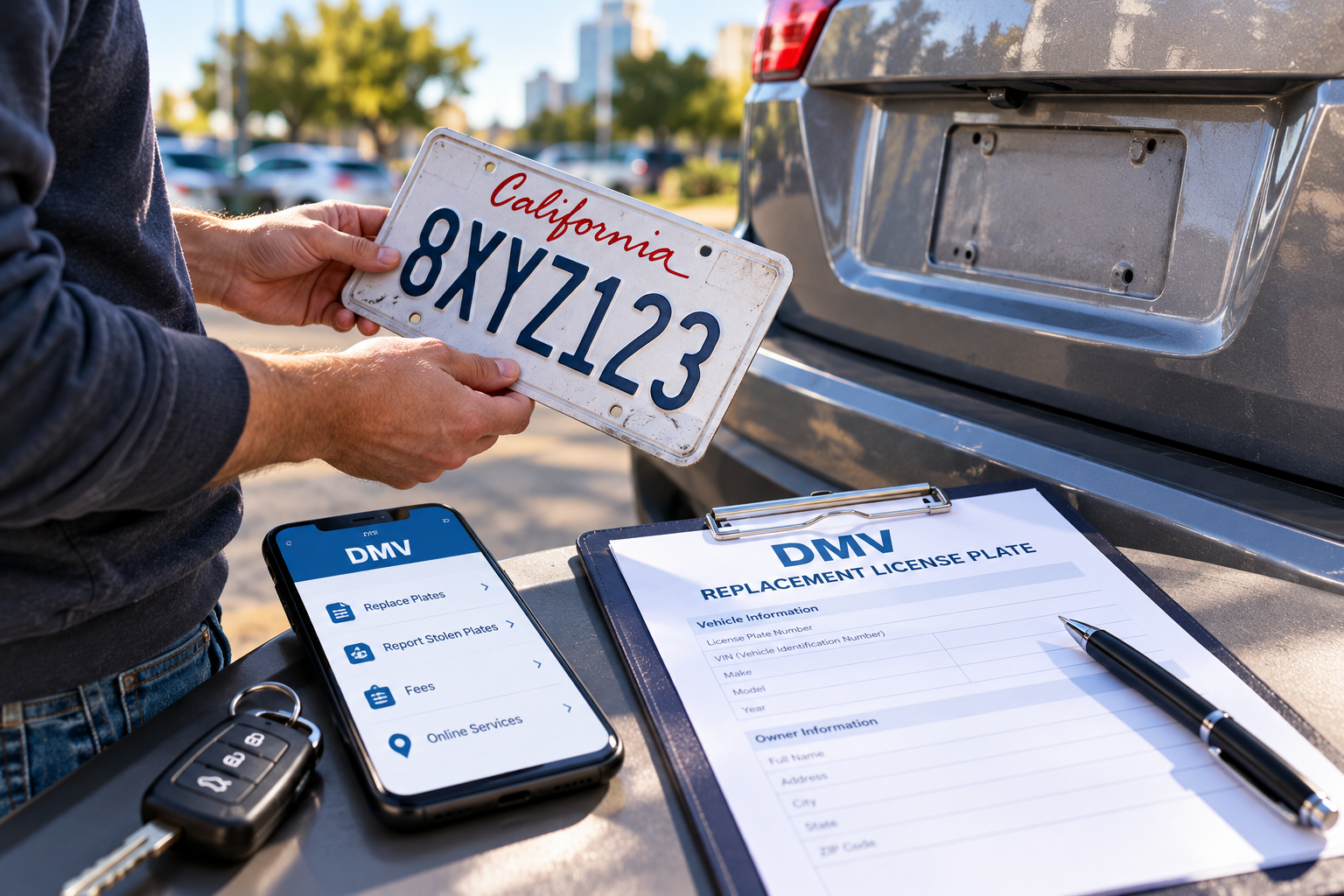
Discovering that a license plate is missing creates more than an inconvenience. A plate may have fallen off because of a damaged bracket, been removed during a theft, become unreadable after an accident, or simply disappeared without an obvious explanation. Whatever happened, the number displayed on the vehicle is connected to its registration record, so replacing the physical plate normally requires action through the state motor vehicle agency rather than buying or making a substitute yourself.
There is no single nationwide replacement procedure. States decide which forms are required, whether a theft must be reported to law enforcement, what happens to a remaining plate, which replacement numbers are issued, and whether an application can be completed online. The correct response is therefore to document what happened, verify the vehicle and registration information, and follow the current instructions of the state where the vehicle is registered.
First Determine Whether the Plate Is Lost, Stolen or Damaged
How the plate disappeared can affect the replacement procedure. A plate that fell from a vehicle because its mounting screws failed may be treated as lost, while a plate deliberately removed from a parked vehicle should be treated as potentially stolen. A plate that remains in your possession but is bent, cracked, peeling, or unreadable can fall under a damaged or mutilated replacement procedure. State forms frequently distinguish between these situations.
Do not automatically select “lost” merely because you did not see anyone take the plate. Look around the vehicle, parking area, garage, and any location where work was recently performed on the car. Check whether the plate bracket or screws show signs of damage or removal. If theft appears possible, follow the law-enforcement and DMV instructions for your state rather than assuming that replacing the physical plate is the only step necessary.
A stolen plate deserves particular attention because someone else could potentially display it on another vehicle. If that plate is then connected with parking violations, toll activity, fuel theft, or another incident, having a timely record of the theft may become important. Reporting requirements differ between jurisdictions, so verify whether your state DMV or local law-enforcement agency requires or recommends a police report.
What to Gather Before Requesting Replacement Plates
A replacement request needs to connect the applicant, vehicle, and registration record accurately. Even when the application itself is short, having the correct information available before you begin helps prevent errors and makes it easier to determine whether your situation qualifies for an online process or requires a mail or office transaction.
Prepare the following information before starting:
- Vehicle Identification Number (VIN).
- Current or missing license plate number, if known.
- Vehicle year, make, model, and body type.
- Current registration card or registration information.
- Registered owner's legal name and current address.
- Government-issued identification.
- Any remaining license plate if the vehicle normally uses two plates.
- Police or incident report information if required for a stolen plate.
- Damaged or mutilated plate remnants that the state requires you to surrender.
These items are a preparation checklist rather than a universal list of documents required in every state. A motor vehicle agency may request additional information depending on the vehicle, registration type, special plate category, address record, or circumstances of the loss. Always compare your documents with the current instructions published by the agency that maintains your registration.
How to Replace a Lost or Stolen License Plate Step by Step
The exact form and submission method depend on the state, but the administrative sequence is generally predictable. The objective is to notify the appropriate authority, identify the correct registration record, invalidate or surrender plates when required, and obtain plates that the state recognizes as valid for that vehicle.
Use this sequence as a practical preparation process:
- Inspect the vehicle and confirm what is missing. Determine whether one plate or both plates are gone and whether the bracket, screws, or surrounding bodywork suggest accidental loss or removal. If a plate is merely damaged but still available, keep it because the motor vehicle agency may require it to be surrendered.
- Record the missing plate number and VIN. Use the registration card, insurance documents, photographs, or other reliable records to confirm the plate number. Copy the VIN carefully from the vehicle or an authoritative document rather than relying on memory.
- Report suspected theft when required. If the circumstances suggest that a plate was stolen, check the instructions of the DMV and local law-enforcement agency. Some replacement procedures require law-enforcement documentation in stolen-plate situations.
- Find the official replacement procedure for your state. Use the state motor vehicle agency rather than an unofficial form website. Confirm which application applies to standard plates and whether personalized, specialty, disability, commercial, trailer, or motorcycle plates follow a different process.
- Complete the application and gather supporting documents. Enter the registered owner's information exactly as required. Include identification, registration evidence, police documentation, remaining plates, damaged plates, or other materials when the state instructs you to provide them.
- Submit the application through an approved method. Depending on the jurisdiction and plate type, replacement may be available online, by mail, through a county office, or at a DMV location. Do not assume that an online replacement service accepts every type of plate.
- Follow the state's instructions for the old plates. A remaining plate may have to be surrendered when the state issues a new set. If a missing or stolen plate is recovered later, do not put it back on the vehicle unless the motor vehicle agency confirms that it is still valid.
Completing these steps in order reduces the risk of ending up with two sets of plates associated with conflicting registration information. It also creates a clearer record of what happened if a missing plate later appears on another vehicle or is recovered after the replacement process has already been completed.
Can You Replace License Plates Online?
Online replacement is available in some states and situations, but eligibility can be narrower than expected. A state may offer an online service for standard sequential plates while excluding personalized plates, disability plates, motorcycles, commercial vehicles, vehicles with registration problems, or cases involving particular combinations of stolen plates.
California currently offers an online replacement service for eligible standard or non-personalized special license plates. Its DMV identifies several categories that cannot use that process, including personalized plates and certain stolen-plate situations. Applicants outside the online eligibility rules may need to use the appropriate form and mail or office procedure instead.
Before beginning an online transaction, confirm that the page belongs to the official state agency and read the eligibility rules. Having an online DMV account does not necessarily mean every replacement can be completed electronically. If your vehicle or plate category is excluded, follow the alternative instructions rather than repeatedly submitting an ineligible request.
Texas uses a separate state procedure. TxDMV Form VTR-60 covers replacement license plates and/or registration stickers when an item is lost, stolen, mutilated, or otherwise needs replacement. The form also requires the applicant to certify that a recovered plate or sticker will not later be displayed or used. This illustrates why drivers should use the form and instructions issued for their own state rather than copying another jurisdiction's process.
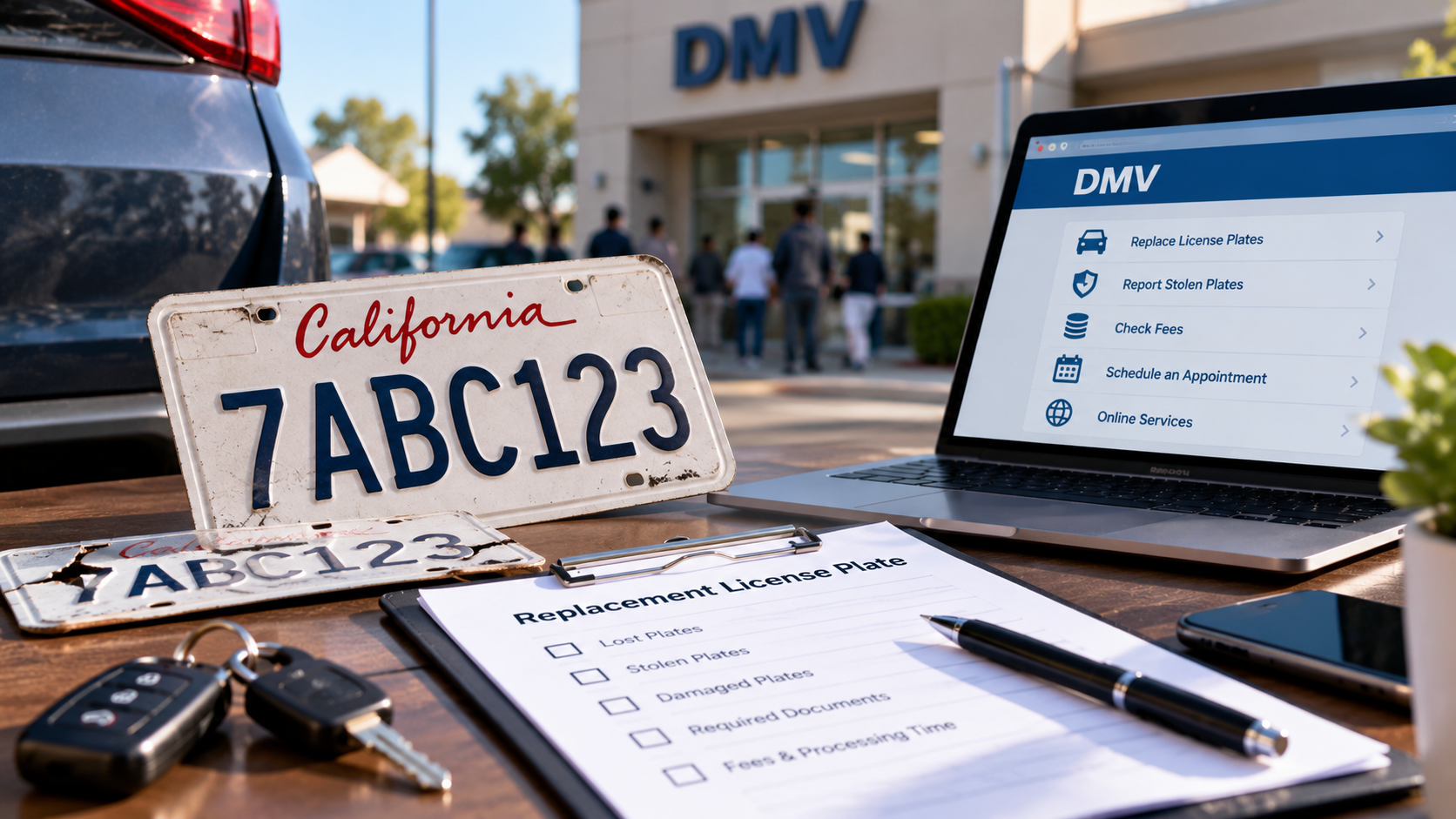
Check the Vehicle Record Before a Sale or Transfer
A missing plate sometimes comes to light just before a vehicle is sold. The seller may be tempted to complete the transaction and leave the buyer to resolve the plate problem, but the plate, registration, title, and transfer requirements can interact differently depending on the state. Resolve the missing-plate issue according to state instructions and make sure both parties understand which plates stay with the seller or vehicle.
Before a private transaction, review the registration information and compare the VIN on the vehicle with the ownership documents. Car2GoEvents' How to Run a VIN & Vehicle History Check guide explains how to verify the vehicle identifier and review available history information, while the How to Transfer a Car Title After a Sale guide covers the separate ownership-transfer process.
Vehicle-history services can provide additional information about records associated with a VIN, although they do not replace DMV registration or title records. Owners researching information connected with a vehicle may also encounter https://hideautovin.com/en. Regardless of any third-party service, only the appropriate government authority can determine whether a plate is valid, cancelled, replaced, or assigned to a particular registration.
Common Mistakes When Replacing License Plates
Most replacement transactions are straightforward once the correct state procedure has been identified. Delays usually arise because an applicant uses the wrong form, overlooks a special plate category, fails to surrender an item that the state requires, or assumes that requirements found for another jurisdiction apply everywhere.
Before submitting the application, check for these common problems:
- Using an unofficial or outdated replacement form.
- Selecting “lost” when the plate was apparently stolen without checking reporting requirements.
- Entering the wrong VIN or previous plate number.
- Forgetting to surrender a remaining or damaged plate when required.
- Assuming a personalized plate qualifies for the standard online process.
- Confusing replacement plates with a replacement registration card or sticker.
- Paying an outdated fee.
- Attempting to display a homemade plate or a plate assigned to another vehicle.
- Reusing a recovered plate after the state has invalidated it.
- Assuming another state's DMV procedure applies to your registration.
A few minutes spent reviewing the application against the official instructions can prevent a return trip, rejected mail request, or incomplete online transaction. Pay particular attention to the registered owner's name and address, identification requirements, the status of any remaining plate, and instructions that apply specifically to stolen plates.
Conclusion
If a license plate disappears, first determine whether it was probably lost, stolen, or damaged and document what happened. Confirm the plate number and VIN, secure any remaining plate, check whether law-enforcement reporting is required, and then use the current replacement procedure published by the state motor vehicle agency that maintains the registration.
Do not treat replacement rules as uniform across the United States. Police-report requirements, surrendered plates, fees, personalized-plate procedures, online eligibility, temporary operating documents, and treatment of recovered plates can all vary. The safest approach is to use the general sequence in this guide as preparation while allowing the official instructions for your state and plate type to control the actual transaction.
Frequently Asked Questions
Do I need a police report for a stolen license plate?
It depends on the state and circumstances. Some replacement procedures require law-enforcement documentation when a plate is stolen, and certain situations involving all plates being missing can have additional reporting requirements. If theft is suspected, check both the official motor vehicle agency instructions and the appropriate local law-enforcement procedure before submitting the replacement application.
Can I replace just one missing license plate?
Possibly, but do not assume the state will simply reproduce one matching plate. In a two-plate jurisdiction, the remaining plate may need to be surrendered and the agency may issue a replacement set or new plate number. Keep the remaining plate secure until you have read the instructions for the state where the vehicle is registered.
Will my replacement plates have the same number?
That depends on the jurisdiction, the type of plate, and why replacement is required. Standard plates and personalized plates may follow different rules, and a state can assign a new number when the previous plates are reported lost or stolen. If preserving a personalized configuration matters, check the specific personalized-plate replacement procedure before applying.
What should I do if I find a plate after reporting it lost or stolen?
Do not immediately reinstall it. Once replacement plates are issued, the previous plate may be invalid in the registration system even though the physical plate is still intact. Follow the motor vehicle agency's instructions for returning or destroying recovered plates, and contact the agency if you are unsure whether the old number remains valid.
Is replacing a license plate the same as replacing the registration?
No. The physical license plate, registration card, and registration sticker are separate registration items even though they are connected to the same vehicle record. States can use different applications or online services for each item. Identify exactly what is missing and use the procedure specified for that item rather than assuming one replacement transaction automatically replaces everything.