
Losing a car title can become a serious problem at exactly the moment you need the document most. You may discover it is missing while preparing to sell the vehicle, trade it in, move to another state, remove a lien, or simply organize your records. The good news is that a lost, stolen, damaged, or destroyed title usually does not mean your ownership disappears. State motor vehicle agencies maintain title records and provide procedures for obtaining a replacement or duplicate title when the original document can no longer be used.
The important complication is that there is no single nationwide replacement-title application. Vehicle titles are administered at the state level, and the terminology, forms, fees, identification requirements, processing methods, and lienholder rules vary. California uses an Application for Replacement or Transfer of Title, Texas calls its replacement a Certified Copy of Title, and New York issues a Duplicate Certificate of Title. Your first task is therefore to identify the state that issued the current title and follow that state's official procedure rather than relying on a generic form found online.
First, Confirm Which State Issued the Title
The state where you currently live is not necessarily the state you need to contact. If your vehicle still has a title issued by another state, the replacement normally has to be handled through the agency responsible for that title record. This becomes particularly important after a recent move, because changing your address or registration does not automatically mean every ownership record has already been transferred to the new jurisdiction.
If you recently relocated and have not completed the new-state vehicle process, determine whether you need to replace the old title first or whether the new state's out-of-state title procedure can address your situation. Our guide on how to register a car after moving to a new state explains why registration, title, insurance, and residency requirements should be treated as related but separate records. Do not submit duplicate-title applications to multiple states hoping that one of them will issue the document.
Replacement Title, Duplicate Title, and Certified Copy
Different agencies use different names for documents that replace a missing title. “Replacement title” and “duplicate title” are common terms, but some states use more specific terminology. Texas, for example, refers to its replacement as a Certified Copy of Title. The name matters because searching for the wrong phrase can lead you to third-party services instead of the correct state application and instructions.
The legal effect also matters. A replacement is not simply an informal photocopy of your previous certificate. It is an official ownership document issued from the state's motor vehicle record. New York specifically explains that once a duplicate title is processed, the original title and any earlier duplicates are no longer valid for transferring the vehicle. Texas similarly states that its Certified Copy of Title replaces the original Texas Certificate of Title and previously issued certified copies.
What Information Should You Gather Before Applying?
A title agency needs to confirm that the person requesting the replacement has authority to obtain the vehicle's ownership document. That usually means matching the application to information already contained in the state record. Preparing those details before starting the application reduces the chance of a rejection caused by an incorrect VIN, outdated owner information, missing identification, or an unresolved lien.
- Vehicle identification number (VIN). Check the number directly against the vehicle and your registration rather than entering it from memory.
- Year, make, and model. Use the description contained in your existing vehicle records whenever possible.
- Current registration. This can help confirm the vehicle information and the owner name associated with the record.
- Government-issued identification. States may require an original ID for an in-person transaction or a copy for a mailed application.
- Owner's legal name and address. Determine whether the title record still contains an old address or former legal name.
- License plate information. Some duplicate-title applications request the current plate number as part of the vehicle identification details.
- Lienholder information. If the vehicle was financed, determine whether a lien is still recorded even if you have already paid the loan.
- Lien release documentation, if applicable. A paid loan does not necessarily mean the lien has already disappeared from the state's title record.
- Payment for the required fee. Confirm both the current amount and the accepted payment method on the official state website.
Not every state will request every item in exactly this form, and additional documentation can be required when an owner has died, a legal name has changed, a company owns the vehicle, an agent is applying for the owner, or a lien is involved. Treat this as a preparation list rather than a substitute for your state's instructions. The official application and agency checklist should always control what you actually submit.
Step-by-Step: How to Replace a Lost Car Title
Once you know which state controls the title record, the process becomes easier to organize. Some states offer an online option for eligible owners, while others rely on mail, in-person service, or a combination of methods. Before choosing the fastest-looking option, make sure you qualify for it, especially if your address has changed or the title includes a lienholder.
- Identify the title-issuing state. Confirm which motor vehicle agency currently maintains the vehicle's title record.
- Open the official replacement-title instructions. Look for “duplicate title,” “replacement title,” or the terminology used by that state.
- Check the owner and lien information. Determine whether the state's record should still show a lender or another legal owner.
- Gather identification and vehicle details. Verify the VIN, owner name, address, registration information, and other required data.
- Complete the correct state application. Use the state's current form or online service rather than a generic document from another website.
- Provide lien documentation if required. A recorded lien may change who must apply or what release must accompany the request.
- Submit the application using an allowed method. Depending on the state and your circumstances, that may be online, by mail, or in person.
- Pay the applicable replacement-title fee. Verify the current fee and accepted payment method before submitting the application.
- Wait for the official replacement document. Do not promise a sale or transfer date based on an assumed processing time.
- Use the replacement as the current title. If the state invalidates prior title certificates after issuing a duplicate, do not use an old document if it later reappears.
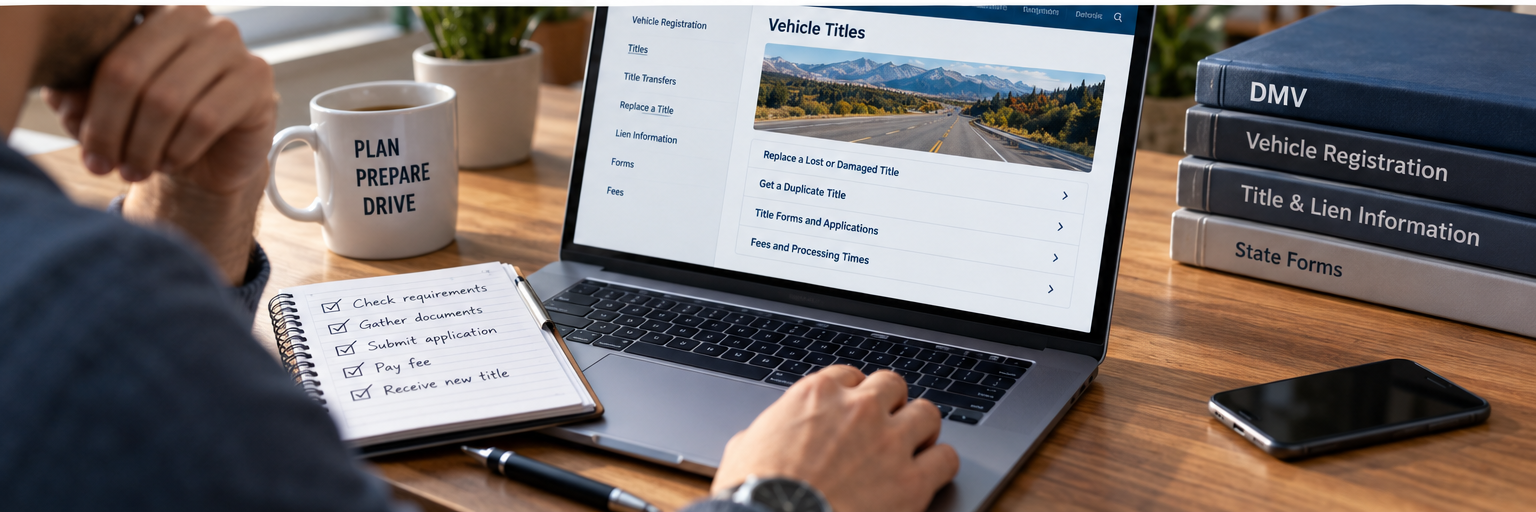
The sequence becomes especially important when a lien, address change, ownership change, or planned vehicle sale is involved. A straightforward duplicate request can become a different transaction if you are simultaneously trying to remove a lender, change an owner's name, transfer the vehicle to someone else, or move the title to another state. Read the instructions for both actions before combining them.
California: Replacing a Lost or Damaged Title
California illustrates how a state can use one form for several related title situations. The California DMV states that if a California title is lost, stolen, damaged, or otherwise unavailable, the owner can use the Application for Replacement or Transfer of Title, Form REG 227. The DMV accepts replacement-title requests under its state-specific requirements, and the form can also be relevant when a missing title is connected to an ownership transfer.
The California DMV title guidance also shows why lien status cannot be ignored. California has additional signature and notarization requirements when a legal owner or lienholder is recorded, and special rules can apply depending on the age of the vehicle. Rather than assuming that a paid loan automatically removes the lender from the process, verify what the DMV record currently shows before completing REG 227.
Texas: A Replacement Is Called a Certified Copy of Title
Texas uses different terminology. If a Texas title is lost or destroyed, the Texas Department of Motor Vehicles allows an eligible applicant to request a Certified Copy of Title using Form VTR-34. The applicant must be an owner or lienholder shown on the department's record, or an authorized agent. Texas also requires identification and applies different submission requirements depending on whether the request is made by mail or in person.
The Texas Department of Motor Vehicles replacement-title instructions contain an especially important warning for vehicles that were previously financed. If a lien remains recorded, the lienholder generally needs to be involved or an acceptable original release of lien must be provided. Texas notes that even a lien that has already been paid may remain on the title record until the necessary release documentation is processed.
New York: What Happens to the Old Title?
New York provides another useful example because its DMV explicitly addresses what happens if the missing document later turns up. A New York owner who qualifies can request a Duplicate Certificate of Title, including through the state's online process in eligible circumstances or by submitting Form MV-902 with the required identification and fee under the applicable procedure.
The New York DMV Certificate of Title guidance states that once a duplicate title has been processed, the original certificate and any previous duplicate titles are no longer valid and cannot be used to transfer the vehicle. This is a valuable rule to remember even outside New York: never assume that finding an old title after receiving a replacement automatically makes the old document usable again. Check the issuing state's rule and use the current valid title.
What If There Is Still a Lien on the Vehicle?
A lien is one of the most common reasons a seemingly simple replacement-title request becomes more complicated. If the vehicle is financed, the lender may be recorded as a lienholder or legal owner and may hold the physical or electronic title. In that situation, the registered owner may not have authority to obtain or modify the title without the lender's participation, depending on the state's title system and the status of the loan.
Start by checking your loan records and contacting the lender if necessary. Ask whether the lender still appears on the state title record and whether it holds an electronic or paper title. Our lien release and title transfer guide explains the broader relationship between a vehicle title and a recorded security interest. Do not confuse making the final loan payment with completing the state process that removes the lien from the ownership record.
What If the Loan Was Paid Off but the Lien Still Appears?
Paying off a car loan and removing the lien from a title record are related events, but they are not always simultaneous. A lender may provide a lien release, transmit an electronic release, or follow another state-specific procedure after the balance is satisfied. If that final record update never occurred, the motor vehicle agency may still treat the lienholder as part of the title record when you request a replacement.
Texas is a clear example. TxDMV explains that a lien may remain recorded even after the loan has been paid and that an original release of lien may be required when requesting a Certified Copy of Title. New York also provides a process for submitting a duplicate-title application together with original proof that a lien has been satisfied. If your paid-off lender still appears in the record, resolve that issue instead of simply omitting the lender from the replacement application.
What If the Title Was Stolen?
A stolen title creates the same practical need for a replacement, but it also raises a document-security concern because someone else may possess an ownership certificate containing your vehicle and personal information. Follow the title-issuing state's instructions for a stolen document and determine whether the agency recommends or requires any additional report or statement. Do not assume that every state uses the same stolen-title procedure.
Once the replacement is issued, keep it secure and pay attention to any unexpected vehicle-record activity. If you are concerned that someone may have attempted to use the missing document, confirm the current title information through appropriate official channels. You can also review our VIN and vehicle history check guide for a broader explanation of how vehicle-identification and history records can be examined when something about a vehicle's documentation appears inconsistent.
What If the Title Is Damaged Rather Than Lost?
A title does not have to disappear completely before it becomes unusable. Water damage, tearing, missing sections, illegible printing, unauthorized corrections, or other physical problems may prevent a motor vehicle agency, dealer, buyer, or lender from accepting the certificate. States commonly provide replacement procedures for damaged or mutilated titles, but the damaged document itself may need to accompany the application.
Do not throw away a damaged title before checking the state's instructions. California's replacement procedures, for example, contemplate mutilated or illegible titles and may require remaining portions of the document as part of the application. A damaged original can still be useful evidence in the replacement process even when it can no longer function as a valid negotiable title for an ordinary ownership transfer.
Can You Sell a Car Without the Original Title?
Selling a vehicle when the title is missing should not be treated as an ordinary private-party sale. A bill of sale, registration card, insurance record, or photocopy of an old title does not automatically substitute for the ownership document required by the buyer's state. The exact solution depends on the jurisdiction, but obtaining the correct replacement before completing the transaction is usually the cleanest way to establish an unbroken ownership record.
If you are preparing for a sale, review our car title transfer guide before signing documents or accepting final payment. Some states have procedures that allow a replacement-title form to interact with a transfer transaction, but those are state-specific exceptions rather than a nationwide shortcut. Make sure both the missing-title issue and the transfer requirements are understood before the vehicle changes hands.
Can You Trade In a Car If the Title Is Missing?
A dealership may have more experience resolving title problems than a private buyer, but that does not mean a missing title can simply be ignored. The dealer still needs legally acceptable ownership documentation before the vehicle can move through its inventory and eventually be titled to another owner. The exact process may depend on whether the title is electronic, whether a lender is involved, and what state maintains the ownership record.
Tell the dealer about the missing title before negotiating the final paperwork. If the dealership says it can handle the replacement, ask what authorization or state form it needs from you and confirm that the procedure complies with the title-issuing state's rules. Avoid signing incomplete title documents or assuming that a dealer can override a state requirement merely because the transaction is a trade-in rather than a private sale.
What If Your Address Has Changed?
An address change can affect which replacement-title methods are available and where the new certificate will be mailed. This is particularly relevant if you lost the title during a move. Some online systems are designed for owners whose current information already matches the motor vehicle record, while a new address may require additional verification, an in-person transaction, or a different application process.
New York, for example, distinguishes between certain online duplicate-title requests and situations involving changes to the owner's information. Before ordering the replacement, confirm that the title agency has the address you are permitted to use and determine whether the address must be updated first. A replacement title mailed to an old residence can create a second lost-title problem immediately after you resolve the first one.
What If the Owner's Name Has Changed?
Marriage, divorce, a court-ordered name change, business restructuring, or another legal event can create a mismatch between your identification and the name appearing on the vehicle record. A duplicate-title request may not automatically update ownership information merely because you enter a new name on the application. States can require supporting legal documents or a separate title-correction procedure.
Read the instructions for both replacement and name changes before filing. If your title is missing and your legal name also changed, the agency may allow the issues to be handled together, or it may require a particular sequence. Providing unsupported information that does not match the existing record can delay the application, so treat the name discrepancy as a title-record issue rather than a spelling correction.
What If You Never Received the Original Title?
A title that never arrived in the mail is not necessarily handled exactly like a title you possessed and later lost. Before immediately paying for a duplicate, confirm whether the issuing agency has a procedure for titles that were mailed but never received. Timing, address accuracy, returned mail, electronic title status, and recent lien activity can all affect what happened to the certificate.
Also verify whether a lender or other lienholder was supposed to receive the title instead of you. In electronic-title states or financed transactions, an owner may expect a paper certificate even though the title is legally maintained or delivered through another process. Confirm the title status first so you do not request a replacement for a document that was never supposed to be mailed directly to you.
Common Mistakes When Replacing a Lost Car Title
Most replacement-title delays come from record mismatches rather than the fact that the paper certificate is missing. The motor vehicle agency already has a title record; your application must establish that you are authorized to receive the replacement and that the vehicle, owner, address, and lien information correspond to that record. Reviewing those details before submission can prevent a second round of paperwork.
- Applying to the wrong state. The agency that maintains the current title record is the key starting point.
- Using an outdated or unofficial form. Download the current application directly from the responsible motor vehicle agency.
- Entering the VIN incorrectly. Compare it with both the vehicle and current registration records.
- Ignoring a recorded lien. A paid loan can still leave a lien on the state record until the required release is processed.
- Assuming a photocopy is equivalent to a replacement title. An official duplicate or certified replacement has a different legal status.
- Using an old title after a replacement has been issued. Some states expressly invalidate the previous certificate when the duplicate is processed.
- Waiting until the day of a sale to request the replacement. Processing and mailing time can prevent the transfer from being completed as planned.
- Discarding a damaged title too early. The state may require the damaged or mutilated certificate to be submitted.
- Failing to resolve an address or name mismatch. Changes to owner information can require additional documentation or procedures.
The safest approach is to treat the replacement application as a verification of the existing ownership record rather than merely a request to print another piece of paper. Confirm who owns the vehicle according to the state, whether a lien remains recorded, where the new certificate will be sent, and whether any other title change needs to happen at the same time.
Replacement Title Checklist
A simple checklist can prevent an urgent title problem from becoming a series of rejected applications. Start with the title record itself and work outward: identify the issuing state, confirm ownership and lien status, verify the vehicle information, and only then select the application method. This is especially useful when the title disappeared during a move or when the vehicle was recently paid off.
- You know which state currently holds the vehicle's title record.
- You are using the current official replacement or duplicate-title application.
- The VIN, year, make, model, and owner information are accurate.
- Your identification meets the state's requirements.
- Your mailing address is correct and acceptable for the chosen application method.
- You know whether a lienholder is still recorded.
- You have the required lien release or lender participation, if applicable.
- You understand whether the damaged original must be surrendered.
- You have confirmed the current fee and accepted payment method.
- You know how the application must be submitted and where the replacement will be delivered.
- You understand whether the old title becomes invalid after the replacement is issued.
- You have allowed enough processing time before a planned sale, trade, move, or other transaction.
Once these points are confirmed, the actual replacement request is usually much more straightforward. Keep a copy of the application and any receipt or tracking information that the agency provides. When the new title arrives, verify the VIN, owner names, lienholder information, and other important details before storing the document securely.
How to Avoid Losing the Replacement Title
A vehicle title is not a document you normally need to carry in the car. Keeping it in the glove compartment can expose the ownership document to theft, fire, water damage, or loss along with the vehicle itself. Once the replacement arrives, store it in a secure location with other important ownership records rather than with everyday registration and insurance documents used on the road.
It is also useful to maintain a private record of the title number, VIN, issuing state, and lien-release paperwork where appropriate. A scan or photocopy can help you identify the document and complete future paperwork, although it does not replace the legal title itself. If the vehicle is financed, retain the lender's payoff and lien-release records even after the loan ends because those documents can become important years later.
Frequently Asked Questions
How do I get a replacement title if I lost my car title?
Start with the motor vehicle agency in the state that currently maintains the vehicle's title record. Look for its official duplicate-title, replacement-title, or certified-copy procedure and verify who is eligible to apply. You will generally need accurate vehicle and owner information, identification, the appropriate state application, a fee, and any required lien documentation. Do not use another state's form simply because the process appears similar.
How long does it take to get a replacement car title?
Processing times vary by state, submission method, mailing time, and whether the application has complications such as a lien or owner-information change. New York, for example, states that an office duplicate-title application is processed within 72 hours after acceptance and then mailed, while other jurisdictions use different timelines. Check the issuing agency's current estimate and leave additional time before a planned sale or trade.
Can I get a replacement title online?
Some states provide online duplicate-title services for eligible owners, but online availability is not universal and may depend on whether your address, owner information, lien status, and other details match the existing record. New York permits online duplicate-title applications in qualifying circumstances. If your information has changed or the vehicle has a lien, you may need to use another submission method.
What happens if I find the old title after getting a replacement?
Do not automatically use the old document. The replacement may supersede or invalidate earlier certificates. New York expressly states that once a duplicate title is processed, the original and any previous duplicate titles become invalid for transferring the vehicle, while Texas states that a Certified Copy replaces the original and previously issued certified copies. Follow the rule of the state that issued your title.
Can I replace a title if my car still has a loan?
Usually there is a state procedure for vehicles with liens, but the lender may need to participate because it can be recorded as the lienholder or legal owner. California and Texas both have additional requirements when a lienholder appears in the title record. Contact the lender and check the issuing state's instructions before submitting the replacement application so you know who must sign and what lien documentation is required.
If you are replacing a title because you plan to sell the vehicle, our selling a car without a title guide explains what to resolve before accepting payment.
Conclusion
Losing a car title is inconvenient, but it does not normally erase your ownership record. The state that issued the title maintains the underlying vehicle information and provides a procedure for replacing a certificate that was lost, stolen, destroyed, damaged, or never received. The key is to use that state's current official process and to distinguish a true replacement title from photocopies, registrations, bills of sale, or unofficial documents that cannot perform the same legal function.
Before applying, confirm the issuing state, VIN, owner information, address, and lien status; then obtain the correct form and follow the permitted submission method. Resolve lender or lien-release issues early, allow enough time before selling or trading the vehicle, and treat the replacement as the current ownership document once it is issued. After it arrives, check the information carefully and store the new title somewhere secure so the same problem does not interrupt your next vehicle transaction.